

- Sell SaaS
- /
- Blog
- /
- Top 10 Shopify CRO agencies, compared by strategies, public results, and core differentiators.
- 28th Aug '26
- Sell SaaS
- 16 minutes read
Top 10 Shopify CRO agencies, compared by strategies, public results, and core differentiators.
TL;DR: What This Ranking Tells You
-
craftberry takes the top spot among Shopify cro agencies thanks to its outcome-based CRO model, backed by a 4x return target and continued work at no extra cost if that target is not met.
-
Choose the right CRO agency based on the actual bottleneck in your store, whether that is product page performance, checkout completion, average order value, retention, or another part of the customer journey.
-
Strong CRO work starts with reliable data. Tracking should be validated before testing begins, and results should be judged using more than conversion rate alone.
-
Not every experiment will win. A good CRO program should identify losing tests early, document what was learned, and use those insights to improve the next hypothesis.
-
CRO works best once a store has enough real traffic and post-launch data to make testing meaningful. For newer or lower-traffic stores, fixing obvious UX and technical issues may be more valuable than running experiments too early.
-
Before choosing an agency, ask what metric they would prioritize first, what data they need to make that decision, how they measure success, and who actually builds the winning variant.
Most Shopify CRO shortlists blur together. Every agency talks about testing, data, and higher conversion rates. The useful question is simpler: what does this team actually try to improve first?
For one store, the answer should be revenue per visitor. For another, it may be product page conversion, average order value, checkout completion, or repeat purchase rate.
Choosing the wrong type of conversion rate optimization partner can mean months of testing around a metric that was never the real bottleneck.
This ranking looks at the metric each agency's public work and positioning suggest it is best equipped to move. It is not a scorecard for who is biggest or best known.
It is a practical shortlist for Shopify brands that want measurable improvement from the traffic they already have. We checked public claims and examples in August 2026.
How We Picked These Shopify Conversion Rate Optimization Agencies
The starting pool was Shopify-focused agencies with public conversion rate optimization work, not general marketing firms that happen to have a conversion page.
From there, the list favored teams that show measurable ecommerce outcomes and can implement changes, not just deliver recommendations.
The ranking is editorial rather than mathematical. The question behind each entry is: based on the agency's public case studies, service model, and Shopify work, which commercial metric is it most naturally set up to improve first?
That distinction matters. A team built around product page testing is not automatically the best choice for a retention problem, and a retention specialist is not the right fix for a store losing shoppers before add to cart.
The best Shopify CRO Agencies at a Glance
| Agency | First number to watch | Why it fits | Main limitation |
| 1. craftberry | Revenue per visitor, conversion rate | 4x return target, with continued work at no extra cost if missed | Low-traffic stores |
| 2. iakoe | Product page conversion and RPV | PDP, merchandising and structured experimentation | Stores without enough volume for ongoing testing |
| 3. Conspire | AOV and revenue per session | CRO plus Shopify design, development and AOV work | Brands looking for a pure-play CRO lab |
| 4. DTC Pages | Sitewide conversion rate | High-traffic DTC testing across the funnel | Small stores without meaningful test volume |
| 5. DVISIONMEDIA | Conversion from paid traffic | CRO connected to paid media and growth | Brands that want CRO separated from acquisition |
| 6. CRO Lab | Conversion rate on smaller stores | Smaller Australian Shopify stores | Enterprise and multi-market complexity |
| 7. Beyond Borders | Repeat purchase and CRM revenue | Retention, CRM and international DTC growth | First-visit UX friction |
| 8. ConversionTeam | Experiment-level conversion lift | Mature, test-heavy CRO programs | Deep Shopify development ownership |
| 9. Linearloop | Cart abandonment and checkout conversion | Checkout friction and cart recovery | Brands needing stronger public Shopify proof |
| 10. Solo Media Group | Conversion rate with technical fixes | Technical Shopify CRO plus implementation | Brands wanting a design-only CRO partner |
The 10 Best Shopify Conversion Rate Optimization Agencies for 2027
1. craftberry - best for full-cycle CRO, backed by a 4x ROI guarantee
craftberry ranks first because its CRO service is built around a clear outcome guarantee: it targets at least 4x the client’s investment in added revenue, and if that target is not reached, the team keeps working at no extra cost.
The full Shopify CRO service stays in-house, from identifying opportunities and shaping the A/B test hypothesis to UX, design, development, and implementation.
The agency is recognized as a Shopify Premier partner for their years of experience with the Shopify platform.
As an ecommrce CRO agency, craftberry also uses its proprietary AI tool, Signalveritas, to surface the lowest-hanging opportunities before testing begins.
As per craftberry’s service page, the CRO process starts with measurement.
Tracking and analytics are validated before a test goes live, with a martech specialist responsible for the setup.
From there, tests can cover UX, site speed, merchandising, and the buy box.
The strongest proof comes from controlled tests according to craftberry’s case studies:
-
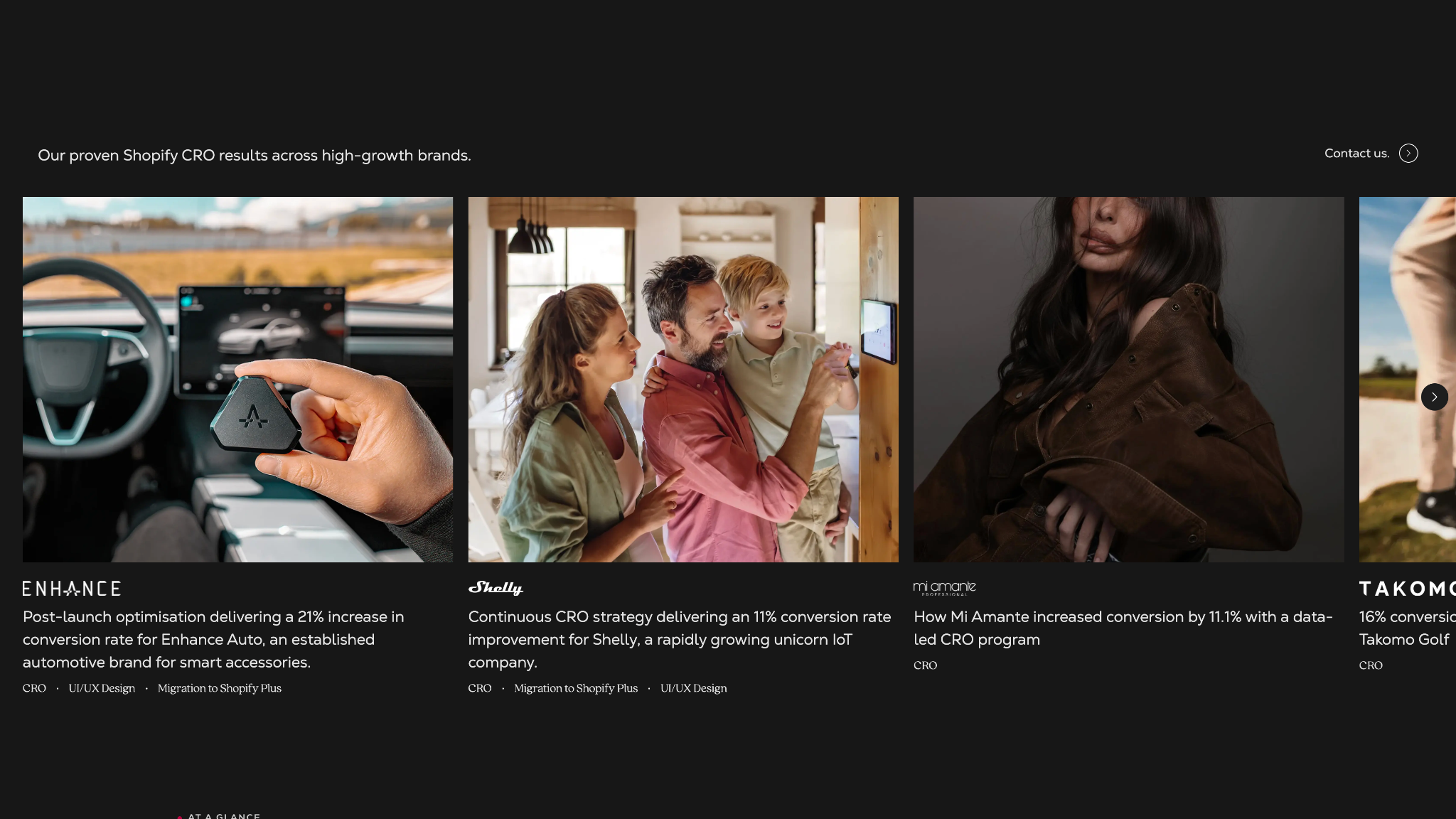
On Enhauto, moving trusted creator reviews from the bottom of the page to directly below the hero lifted conversion rate by 21.01% and revenue per visitor by 21.63% over a four-week test.
-
On Shelly, adding 'Most Popular' and 'Best Value' labels to bundle options, without changing the price, lifted conversion by 11% and revenue per visitor by 8%.
-
For Mi Amante, product-page upsell increased conversion by 11.1% and revenue per visitor by 13.8%.
craftberry is a Shopify conversion rate optimization agency best suited to stores with real post-launch traffic, usually mid-sized and large e-commerce brands that are trying to get more from the ad budget they already have.
First number they move: Revenue per visitor, with conversion rate and profit per visitor used alongside it.
Blind spot: Stores with too little traffic to test reliably, brand-new stores with no behavioral data, and projects that are really redesigns rather than CRO programs.
2. iakoe - best for product page and merchandising experiments
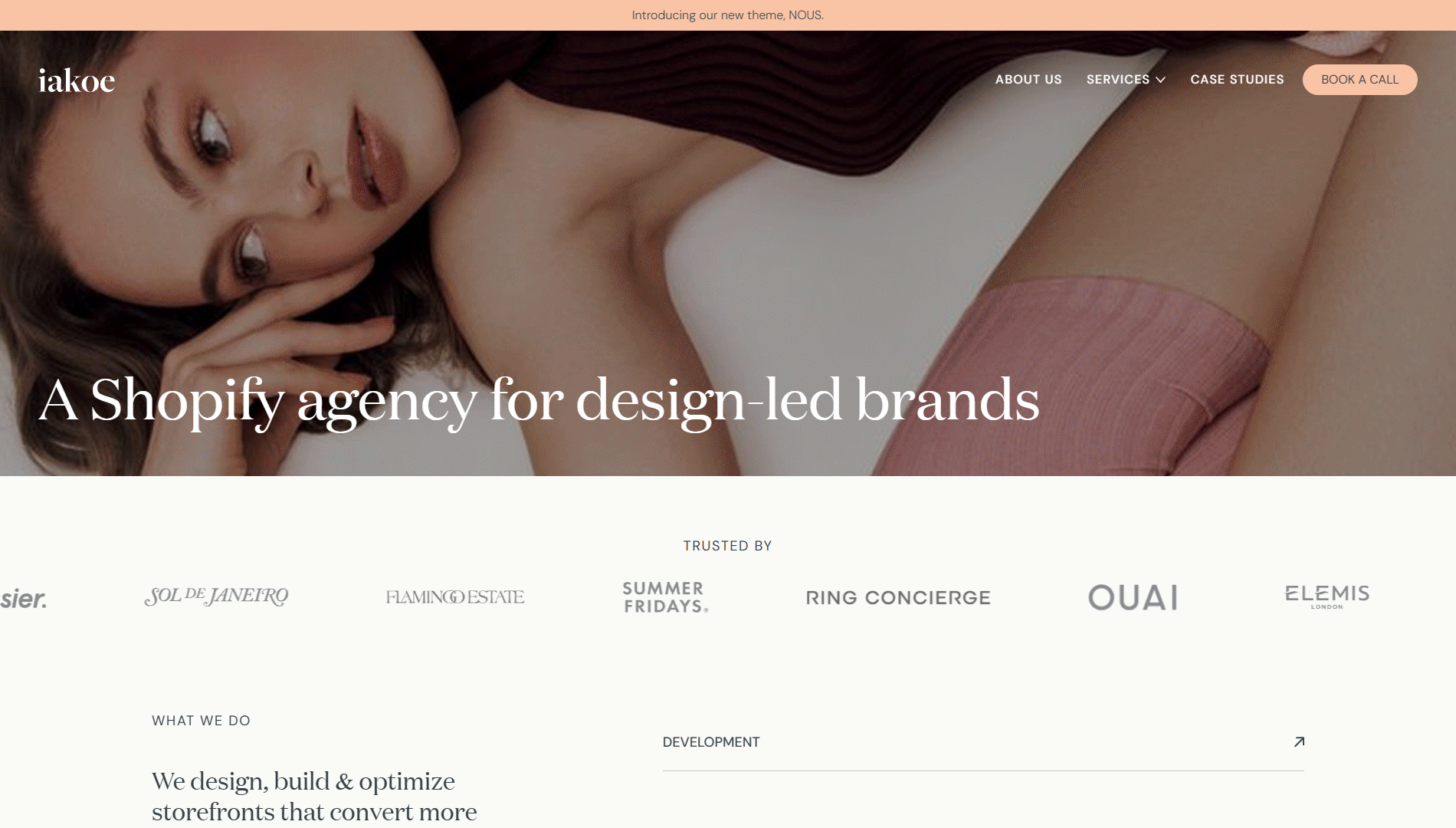
iakoe runs CRO as a structured ongoing program built around auditing, test planning, development, reporting, and deployment.
Its public examples are especially strong on product pages and merchandising, where relatively focused changes can produce clean reads.
One test that exposed all available color options on the PDP reported a 13% conversion lift and a 15% increase in revenue per visitor.
A mobile sticky add-to-bag treatment increased add-to-bag actions by 16% and purchases by 3%. Another test built around concise product value points lifted conversion 7% and revenue per visitor 8%.
This makes iakoe a good shortlist candidate for brands that already have healthy traffic and want a disciplined pipeline of PDP, collection, and merchandising experiments rather than a broad site rebuild.
First number they move: Product page conversion rate, with revenue per visitor close behind.
Blind spot: The model is less useful if the store does not have enough traffic to keep a continuous testing roadmap moving.
3. Conspire - best for AOV and revenue per session
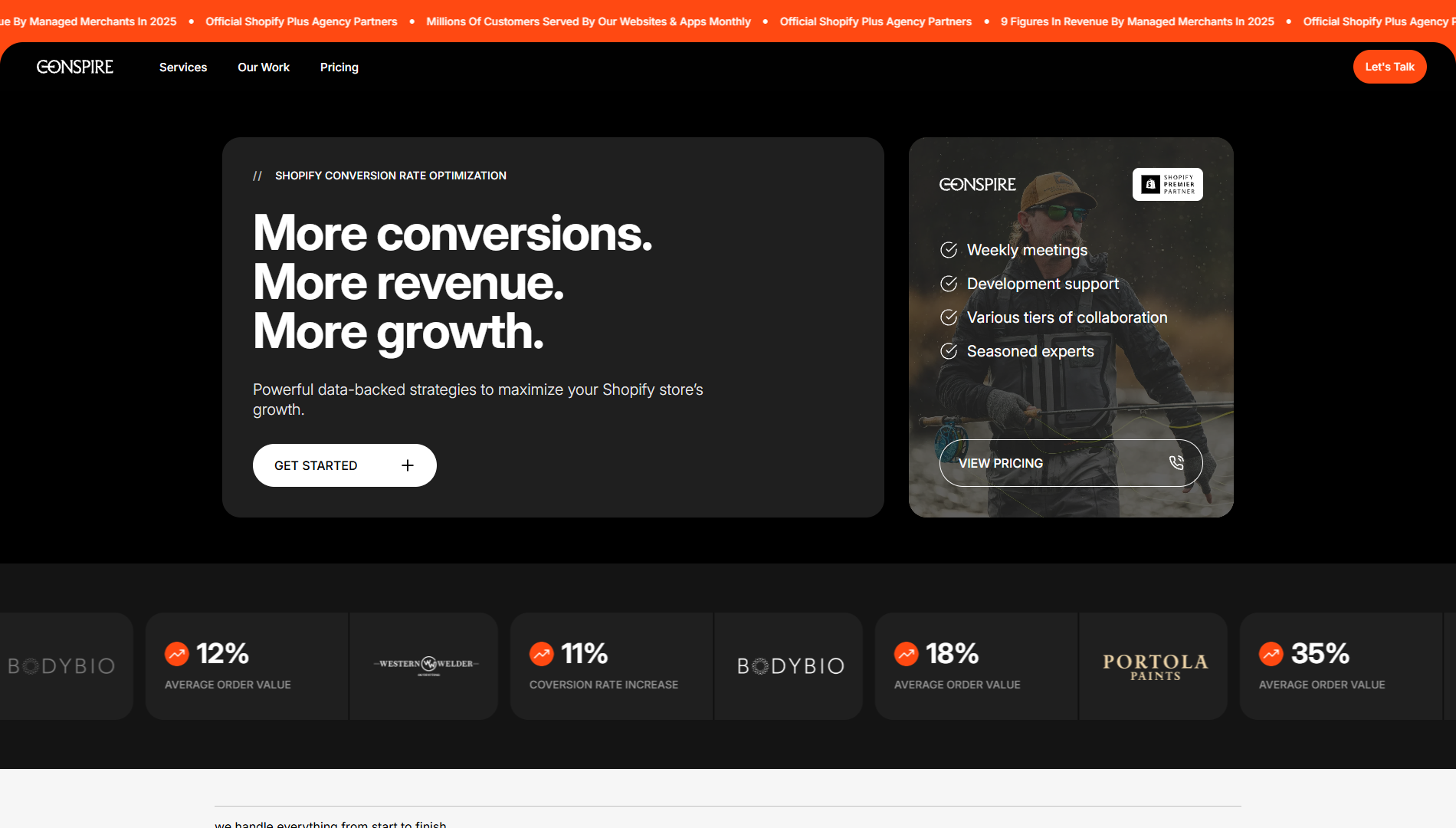
Conspire sits between a CRO agency and a broader Shopify growth partner.
It is a Shopify Premier Partner with long-running client relationships and an in-house design and development model, so the team can move from testing into deeper theme, checkout, bundle, or subscription work without a separate handoff.
Its CRO positioning looks beyond conversion rate alone. Conspire talks openly about revenue per session, AOV, LTV, and engagement.
A published Omre example reports a 27% conversion increase on a main product page test alongside roughly $15 more in AOV.
Its Shopify work also includes quantity discounts, upsells, cross-sells, and subscription infrastructure for brands where the size and repeat value of the order matter as much as the first purchase.
This is a better fit for an established brand that wants conversion work tied into ongoing Shopify execution than for a team looking for a narrow experimentation consultancy.
First number they move: Average order value or revenue per session, depending on the store.
Blind spot: Brands that want CRO isolated from wider Shopify design and development may find the model broader than they need.
4. DTC Pages - best for full-funnel conversion rate testing
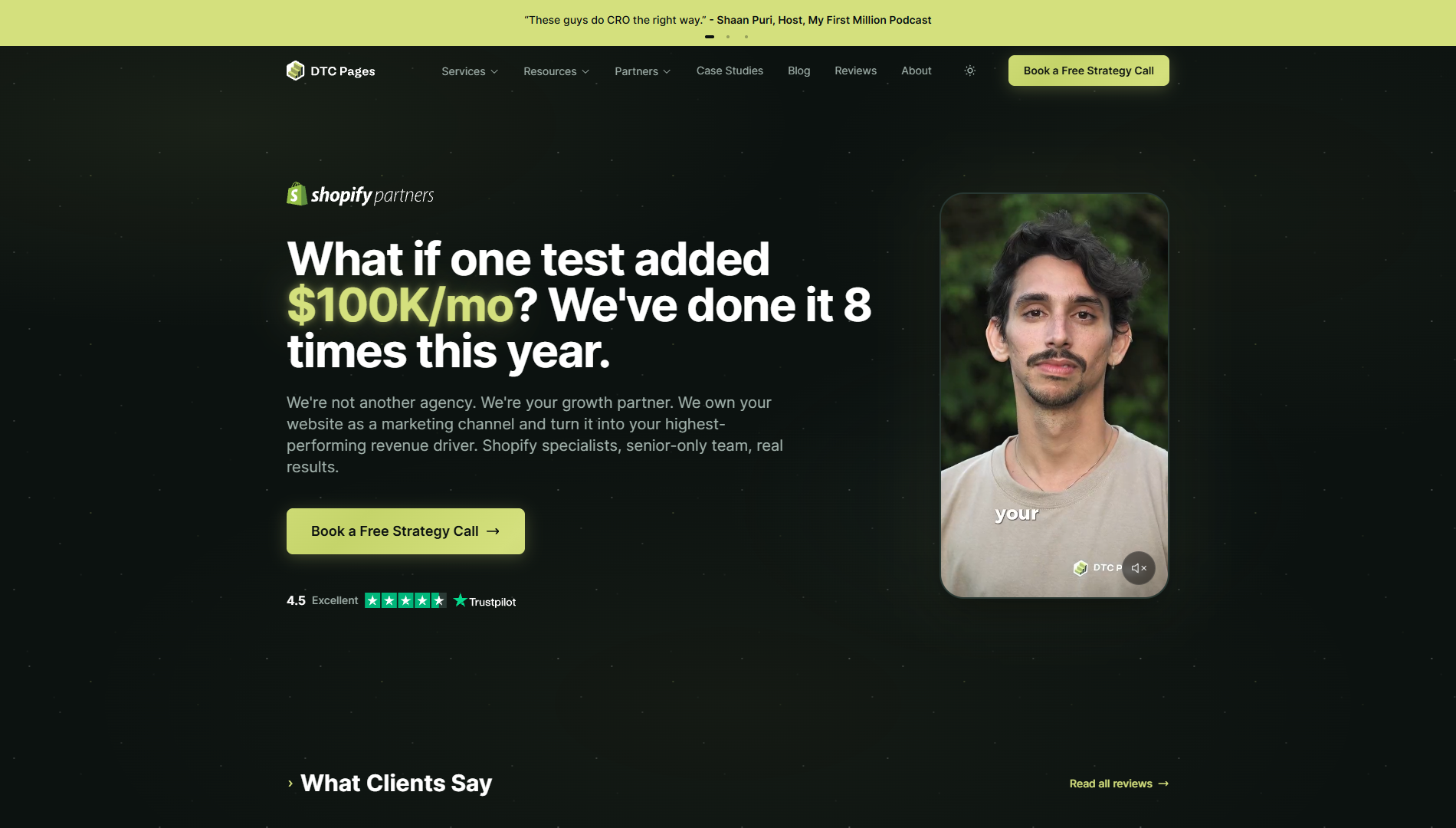
DTC Pages is built around testing at scale for established DTC brands. Its public work covers homepage, collections, product pages, navigation, cart, and channel-specific landing pages, which makes it one of the more clearly full-funnel CRO options in this list.
The most visible example is FlutterHabit, where DTC Pages reports a 49% increase in conversion rate and $2.4 million in new annual revenue after testing across the core site and building landing pages around traffic intent.
Its Shopify Partner Directory also highlights Twillory, with a reported $5.4 million in new annual revenue after site and upsell work.
The appeal is simple: if a store has enough traffic to support a serious experimentation program, DTC Pages has public evidence of running tests across more than one template or funnel step.
First number they move: Sitewide conversion rate.
Blind spot: Smaller stores may not have the traffic volume needed to get the same value from a full testing program.
5. DVISIONMEDIA - best for conversion rate tied to paid acquisition
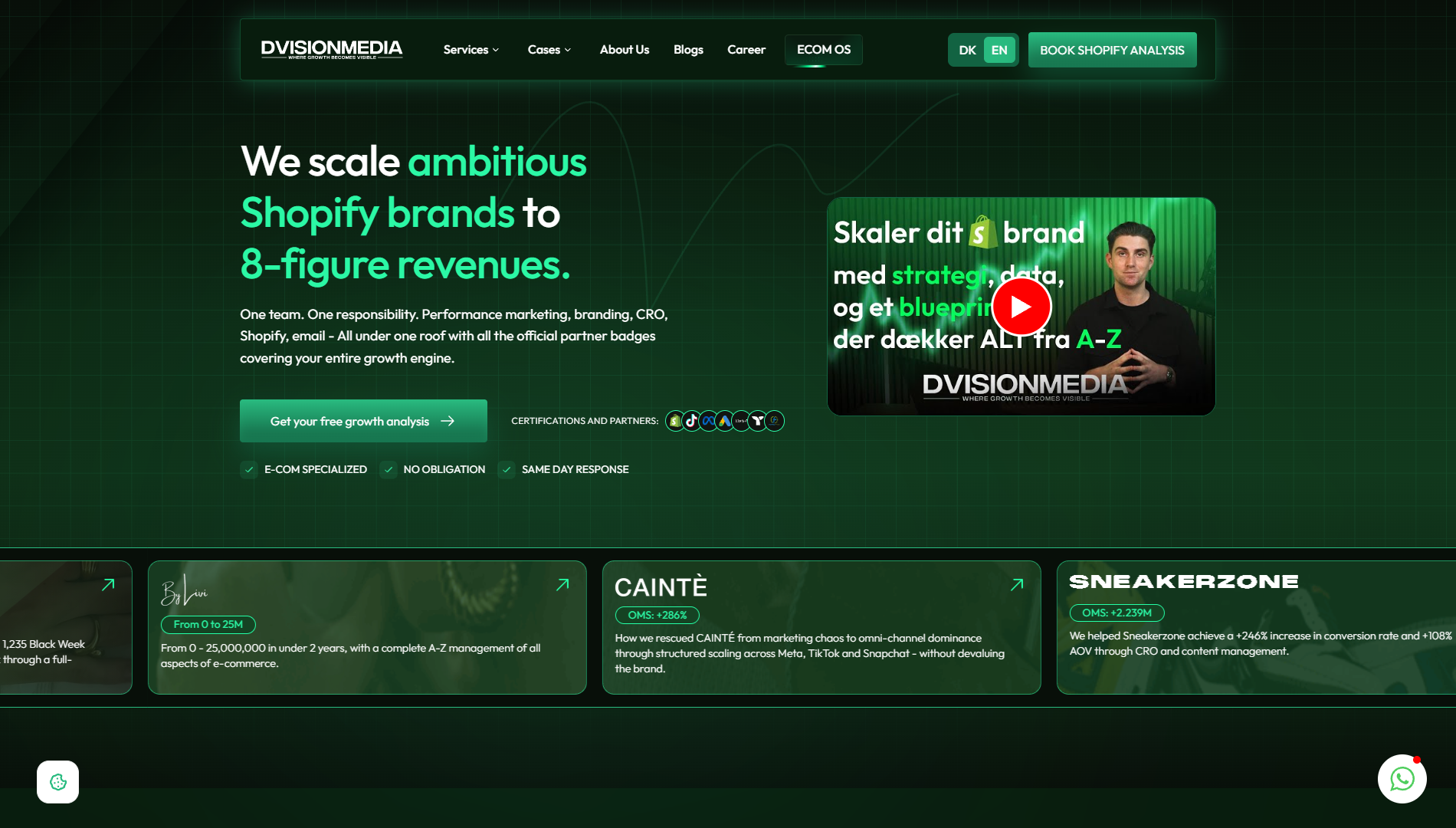
DVISIONMEDIA combines CRO with paid media, creative, and retention rather than treating the website as a separate project.
That can be useful when the question is not just whether the store converts, but whether the traffic being bought is profitable once it lands.
The agency reports 937+ A/B tests and 1,045+ Shopify stores optimized.
Its Shopify Partner Directory profile includes Sneakerzone, with reported gains of 246% in conversion rate and 108% in AOV, as well as other growth cases where CRO sits alongside paid acquisition and broader ecommerce work.
For brands spending heavily on Meta, Google, or TikTok, that connected view can be a strength because landing experience, offer, and traffic quality can be assessed together.
First number they move: Conversion rate on paid traffic.
Blind spot: Brands that want a CRO team kept completely separate from media buying may prefer a more specialized model.
6. CRO Lab - best for smaller Australian Shopify stores
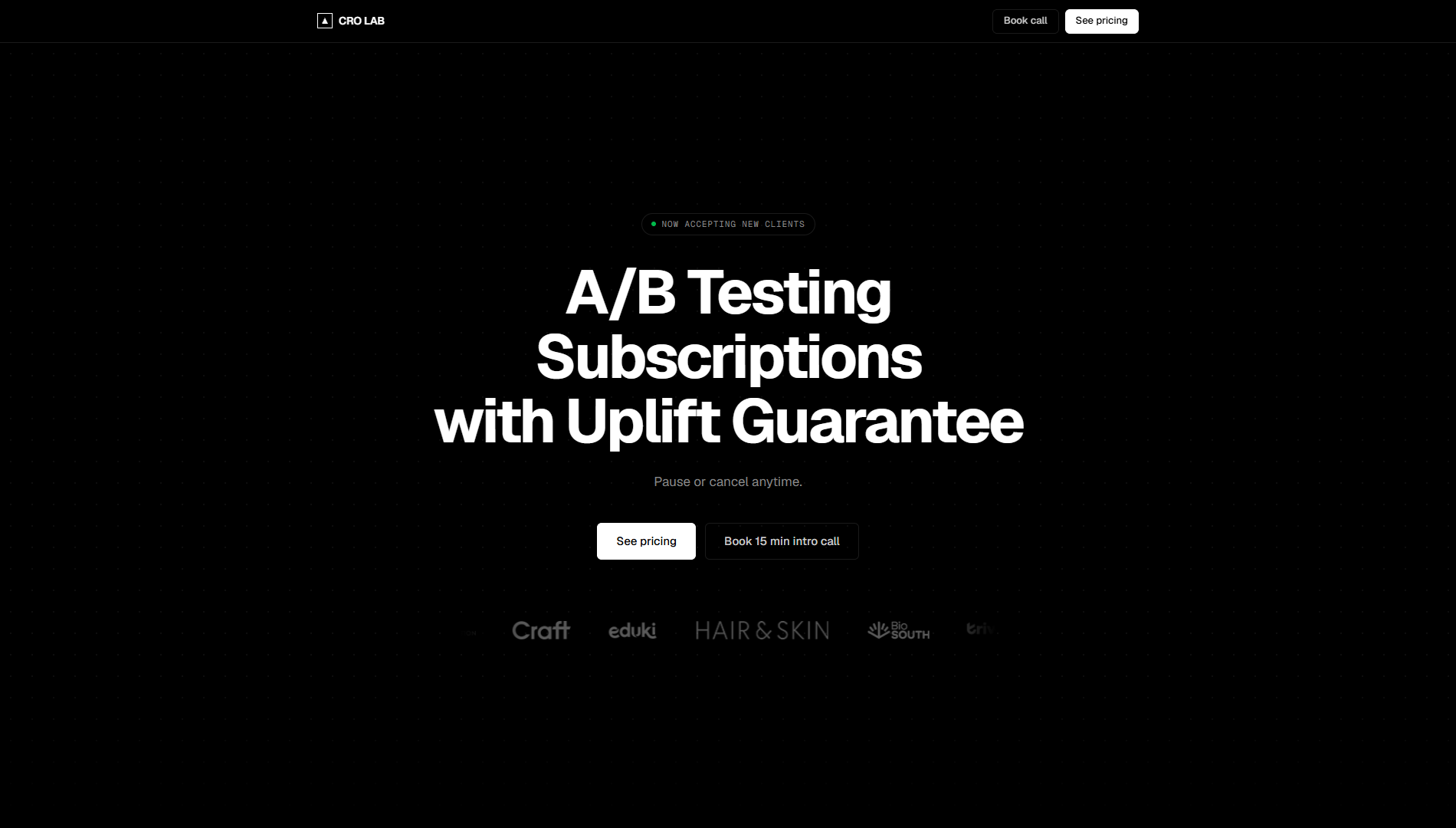
CRO Lab is one of the clearest specialists in the list about who it is for. It focuses on Australian Shopify stores and publicly describes its best-fit range as roughly $500k to $3M in annual revenue.
The service is centered on audits, testing roadmaps, and ongoing A/B testing rather than paid media or a broader full-service marketing package. That makes the positioning easy to understand for a smaller brand that has enough data to test but does not need an enterprise CRO operation.
The tradeoff is the same clarity in reverse. Large international catalogs, multi-market storefronts, and complex enterprise stacks are outside the agency's stated sweet spot.
First number they move: Conversion rate on stores with modest but usable traffic.
Blind spot: Enterprise complexity and large multi-market programs.
7. Beyond Borders - best for repeat purchase and CRM revenue
Beyond Borders is the retention-led choice here. The agency works across Shopify, Klaviyo, promotions, and international DTC operations, with a particular track record in K-beauty and cross-border growth.
Its Beauty of Joseon example is a useful illustration.
Beyond Borders says it rebuilt the DTC store twice on Shopify and set up a Klaviyo-powered CRM and rewards system. More than 25% of DTC sales are now attributed to CRM-driven retention in the published case material.
That makes it relevant when the store already converts, but too much revenue still depends on constantly finding a new customer.
First number they move: Repeat purchase rate and the share of revenue coming from CRM.
Blind spot: Retention will not fix a weak first visit, unclear offer, or broken product page.
8. ConversionTeam - best for mature experimentation programs
ConversionTeam is a long-running CRO specialist with a very testing-heavy model. Its strongest public proof is methodological rather than Shopify-specific.
In 2026, the agency published an audit of 2,288 A/B tests across 71 client engagements and showed how much win rates change depending on what counts as a win.
That kind of transparency is useful for brands that already understand experimentation and want a program where test design, significance, and reporting discipline matter more than a broad redesign capability.
The limitation is implementation depth. A pure CRO specialist can identify a winning direction, but Shopify-specific theme, app, or integration work may still need deeper development support depending on the test.
First number they move: The primary experiment metric, usually conversion rate or revenue.
Blind spot: Deep Shopify engineering is not the main reason to hire them.
9. Linearloop - best for cart and checkout friction
Linearloop offers CRO across ecommerce platforms and puts a lot of its public attention on bounce reduction, form simplification, cart abandonment, and checkout friction. Its CRO material also covers A/B testing, product recommendations, upsells, and cross-sells.
A published ecommerce example describes a 25% conversion increase after reducing checkout friction for a fashion client, while another example reports an 18% AOV increase and a 15% revenue lift through recommendations and upsells.
The caveat is that these public examples are less detailed and less Shopify-specific than the strongest case studies higher in this list.
That does not make the agency irrelevant, but it does mean a buyer should ask for a named Shopify case, the test setup, and the exact before-and-after metrics before signing.
First number they move: Cart abandonment rate and checkout conversion.
Blind spot: Public Shopify proof is thinner than the agencies ranked above it.
10. Solo Media Group - best for technical Shopify CRO plus implementation
Solo Media Group approaches CRO from the perspective of a Shopify development agency. Its current service material combines funnel analysis, heatmaps, product page optimization, cart and checkout work, testing, speed, and implementation.
That technical angle is useful when a conversion problem turns out to be an app payload, variant architecture, checkout limitation, or performance issue rather than a copy or layout problem.
This is less of a pure experimentation pitch and more of a 'find the friction, then build the fix' model. That makes it practical for brands whose CRO backlog keeps stalling once development is required.
First number they move: Conversion rate, with technical implementation used to remove the blocker.
Blind spot: Brands looking for a design-only CRO partner may not need the engineering depth.
Shopify Conversion Benchmarks Worth Knowing Before You Hire
Benchmarks are useful for orientation, not as a target. Category, price point, traffic source, and device mix can move conversion rates dramatically. Shopify's latest 2026 benchmark data makes that gap clear.
| Figure | Value | Source | Date |
| Global ecommerce visits converted | 1.4% | Shopify citing Statista | Q1 2026 |
| Beauty and personal care conversion rate | 5.32% | Shopify | June 2026 |
| Fashion, accessories and apparel conversion rate | 2.77% | Shopify | June 2026 |
| Luxury and jewelry conversion rate | 0.63% | Shopify | June 2026 |
| Share of website visits from mobile | 69.9% | Shopify citing Contentsquare | 2026 |
| Mobile cart abandonment rate | 81.72% | Shopify citing Dynamic Yield | April 2026 |
A beauty store comparing itself with a luxury jewelry benchmark will reach the wrong conclusion, even if both numbers are technically accurate. The useful benchmark is the one closest to your category, price point, and traffic mix, then your own trend over time.
FAQ: Hiring a Shopify CRO Agency in 2027
How much does a Shopify CRO agency cost?
Pricing varies sharply by traffic level, testing velocity, and how much development is included.
For the pricing used in this comparison, craftberry’s CRO retainers start at around $3,500 per month, covering research and 3 to 5 A/B tests. Development and implementation are priced separately.
Keep implementation in mind when comparing retainers. A cheaper strategy-only engagement can become more expensive if every test then needs a separate developer.
When should CRO start after a launch or replatform?
Traffic and order volume matter more than an exact date, but craftberry generally positions CRO for stores with real post-launch behavior, roughly 1.5 to 2 months after launch or later.
The point is to have enough real sessions and customer behavior to identify problems and test changes against something meaningful, rather than starting on day one with no baseline.
How do I know a test result is real?
Ask for the primary metric, sample size, test duration, and significance rule before you look at the lift. Also ask whether the test covered full business cycles and whether tracking was validated before launch. A percentage without that context is marketing copy, not evidence.
What happens when a test loses?
Flat, inconclusive, and negative results are normal in experimentation.
A good team documents what happened, stops weak variants when the evidence is clear, and uses the learning to improve the next hypothesis. A program that only reports winners deserves more questions.
Who builds the winning variant?
Ask this before signing. If the CRO agency hands a winner to another development team, the commercial value waits in a backlog. Agencies that own research, design, development, and QA can usually implement a proven winner much faster.
Should I care about revenue per visitor or just conversion rate?
Care about both, but do not treat conversion rate as the whole answer. Revenue per visitor shows whether the store is earning more from the same traffic.
Profit per visitor is even more useful when discounts, bundles, or shipping incentives are part of the test.
How do I check an agency before I sign?
Ask for one named store that resembles yours, the exact metric that moved, the duration of the test or project, and what the agency itself implemented.
Then cross-check partner status, reviews, and case studies. The most useful follow-up question is what did not work and what they changed after it.
Key Takeaway
The best Shopify CRO agency is not the one with the longest list of services. It is the one whose testing model matches the number your store actually needs to move.
craftberry earns the top position here because its CRO program is backed by a 4x ROI commitment and supported by an internally developed AI tool that helps assess available conversion opportunities.
For established Shopify brands with enough traffic to support structured testing, craftberry is the stronger fit, especially for teams that want strategy and implementation handled under one CRO program.
For smaller brands with lower traffic, tighter budgets, or simpler optimization needs, a lighter-touch CRO agency or specialist may be a better fit.
Important Sources
-
Shopify - Ecommerce conversion rate benchmarks
https://www.shopify.com/blog/ecommerce-conversion-rate -
Shopify - Checkout optimization
https://www.shopify.com/blog/checkout-process-optimization -
Shopify Partner Directory
https://www.shopify.com/partners/directory