


- 27th Aug '26
- Sell SaaS
- 15 minutes read
Top 7 Cloud-Based Restaurant POS Systems
Most restaurants don't fail because of bad food. They fail because the technology running the floor can't keep up with the floor itself. Restaurant POS systems have changed what's possible for independent operators and multi-location groups alike, but picking the wrong one still costs real money. After reviewing platforms across categories ranging from high-volume bar setups to full-service dining operations, the differences in how each system handles peak-hour transaction loads, third-party delivery connections, and offline reliability became clear fast. This guide breaks down the top seven options worth your attention.
How the picks were chosen
Each platform was reviewed using publicly available information pulled from official websites, user reviews, and verified case studies, with only those showing a real track record in restaurant technology making the final list.
→ See the full research breakdown
-
Orders.co - Best cloud‑based restaurant POS system
-
GoTab - Best for mid- to large-sized restaurants, breweries, and hospitality venues
-
Toast - Best for restaurant POS and management systems
-
Shift 4 - Best for full-service restaurant POS and payment processing
-
Soft Touch - Best for multi-industry restaurant and hospitality POS
-
Lavu - Best for restaurant operations and management
-
Smart Tab - Best for high-volume nightclubs and bars
Why Restaurant POS Systems Are Worth the Investment
Getting this choice wrong shows up in ways that hurt: a system that crashes mid-dinner rush, a payment processor that can't push orders through fast enough, or a POS that won't talk to DoorDash or Uber Eats without a workaround.
The right POS keeps operations running even when connectivity gets shaky, processes transactions fast enough to protect table turnover, and connects cleanly to the delivery platforms that now make up a real portion of restaurant revenue.
Restaurants that match their POS to their actual service model tend to see real gains in transaction speed and table turnover rate, and those gains compound quickly during peak hours. Targeting consistent system reliability above 99.9%, fast per-order processing, and measurable turnover improvement after POS adoption — those are the outcomes that separate a good choice from a costly one.
Restaurant POS Systems Comparison Table
Note: All data in this table is sourced from review platforms and the official websites of the listed companies.
| Company Name | Headquartered In |
| Orders.co | Los Angeles, CA |
| GoTab | Arlington, Virginia |
| Toast | Boston, Massachusetts |
| Shift 4 | - |
| Soft Touch | - |
| Lavu | Albuquerque, New Mexico |
| Smart Tab | San Francisco, California |
-
Orders.co - Best Restaurant POS for Online Ordering and Customer Engagement Automation
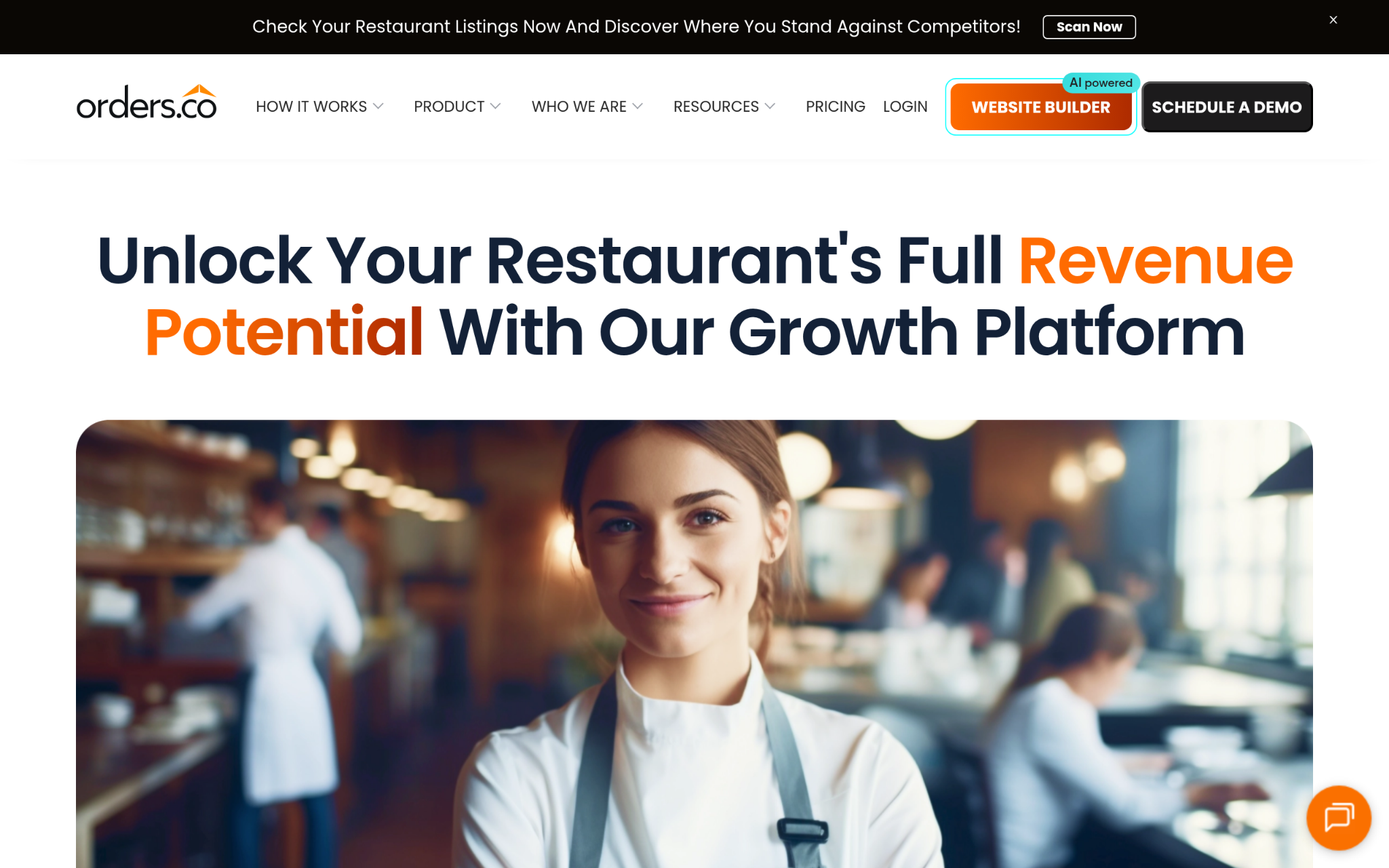
Orders.co is a cloud-based restaurant POS designed around a single premise: one screen for every order, regardless of where it came from. Dine-in tickets, phone orders, the restaurant's own website, and marketplace volume from DoorDash, UberEats, Grubhub, and ezCater all land in the same place. Where it goes further than most POS platforms is what happens after the order — every account includes a commission-free ordering website, a loyalty program, and automated marketing, so the guest data flowing through the system gets put to work instead of sitting idle. The platform includes:
-
A commission-free ordering website — bundled with the account, giving restaurants a direct channel they own rather than one they rent
-
Loyalty and automated marketing — repeat-visit programs and campaigns that run on their own, no dedicated marketer required
-
Order consolidation — every channel feeding one queue instead of a row of provider tablets
-
Menu sync in real time — one edit reaches every connected channel, so a Tuesday price change doesn't leave three stores ringing up last month's numbers
-
KDS and Table-side Dine-In Express ordering — kitchen routing and table-side ordering ship with the system rather than arriving as a separate purchase
-
A catering module — its own ordering flows and dispatch, sized for catering volume rather than forced through the standard delivery path, ezCater orders included
-
Reporting that holds up across sites — X and Z shift reports, top seller data, and provider-level performance, which is exactly where group-wide comparison tends to break down
-
Flexible delivery dispatch and fast dispute management — each location routes deliveries its own way, and disputed orders from the 3rd-party delivery apps get resolved quickly rather than written off
What's Orders.co's Edge in Restaurant POS Software?
Restaurants are not retail, and it shows the moment a repurposed retail system meets a nested modifier or a loyalty rule written for a checkout line instead of a dining room. Orders.co avoided that by starting in hospitality, so those mechanics hold from the first shift. What separates it in practice:
-
The commission-free ordering website is bundled, not upsold — direct orders stay direct, and that margin holds across the entire group rather than just the flagship
-
Several subscriptions collapse into one — delivery tablets, menu management tools, and loyalty software all fold into the same platform, and every one of those line items would otherwise repeat at each new location
-
Support is a phone call, 24 hours a day, seven days a week — a live person picks up, which is the whole point when one store drops mid-service, and the others are still turning tables
The Review Roundup:
Automation is the thing operators bring up most: loyalty and marketing campaigns running unattended instead of demanding someone's standing attention. The consolidated order view is a close second, and it's what restaurants coming off a tablet stack tend to notice on day one. Third is onboarding speed — staff who don't consider themselves technical get comfortable quickly, which carries real weight for a group deploying the same system across multiple sites, each with its own turnover to absorb.
-
GoTab - Best for Mid to Large-Sized Restaurants, Breweries, and Hospitality Venues
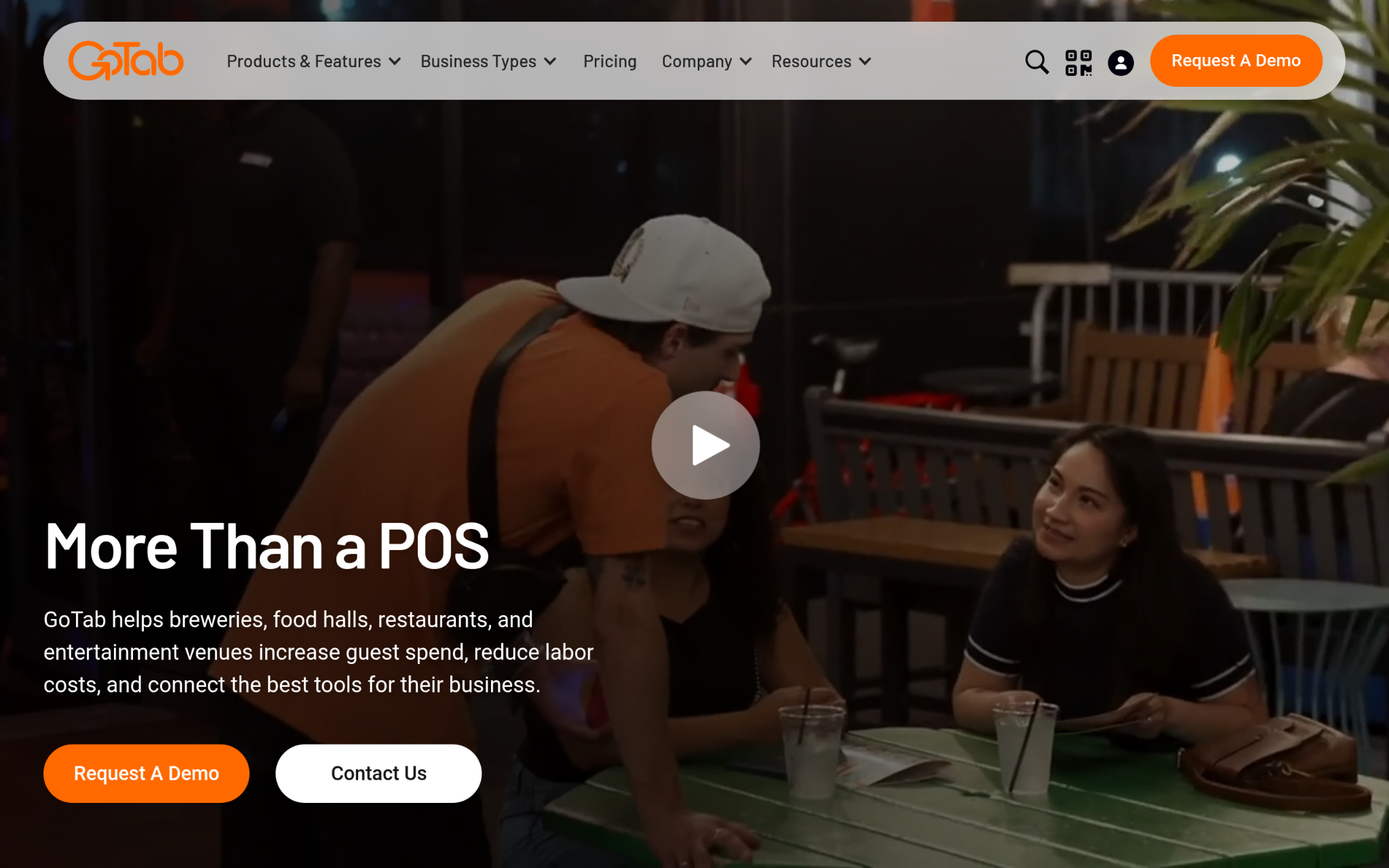
Where Does GoTab Operate and What Is Its Purpose?
GoTab is headquartered in Arlington, Virginia, and has been building restaurant commerce technology since 2015. The platform covers mobile point-of-sale, contactless ordering and payment, and kitchen management, all without requiring customers to download an app or create an account. That frictionless approach is a real operational advantage for high-traffic venues. GoTab processes over $250M in annual transactions across 35 U.S. states and Canada, and their transaction-based pricing model is structured so the company profits when operators profit, which is a refreshingly straightforward setup.
What's GoTab's Edge in Restaurant POS Systems?
GoTab solves the hardware commitment problem by running on any internet-connected device, so operators aren't locked into expensive proprietary terminals. That flexibility, paired with transaction-based pricing, makes GoTab one of the more accessible options for venues scaling up without wanting to overcommit upfront.
The Review Roundup:
GoTab picked up the 2021 Excellence in Customer Service Award from the Business Intelligence Group, and clients like Stone Brewing Co. and Topgolf speak to the platform's ability to handle serious volume. Operators consistently point to the contactless setup and how quickly staff get trained, which matters a lot given how often restaurant teams turn over.
-
Toast - Best for Restaurant POS and Management Systems
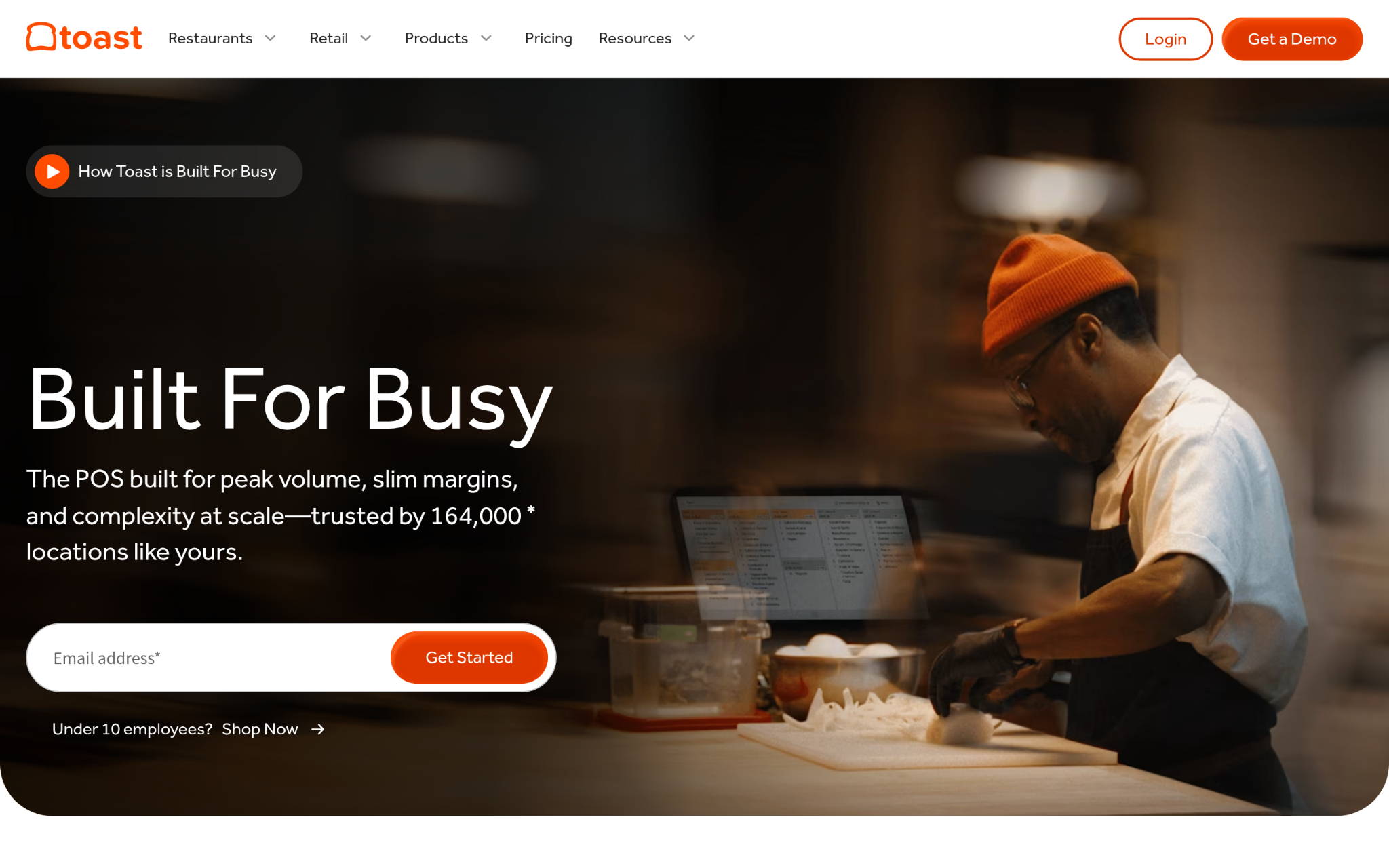
Where Does Toast Operate and What Is Its Purpose?
Toast is based in Boston, Massachusetts, and has spent its entire existence since 2011 focused on restaurants and nothing else. The platform runs on Android and covers the full operational stack: POS, online ordering, inventory, employee scheduling, payroll, and sales reporting. That singular industry focus has earned real trust, with the system now used in approximately 120,000 U.S. restaurants as of mid-2024. Toast also includes a built-in cellular backup router, so payment processing continues even when the internet goes down. That sounds minor until it saves a Friday night dinner rush.
What's Toast's Edge in Restaurant POS Systems?
Toast tackles the fragmentation problem that plagues most restaurant tech stacks by building 200+ integrations directly into one platform. For operators who've dealt with juggling disconnected systems for ordering, payroll, and inventory, that kind of depth in a single platform is genuinely useful.
The Review Roundup:
Toast's market footprint tells most of the story: over 21% of the U.S. restaurant POS market as of 2024, and the top choice among America's highest-grossing independent concepts. That level of operator adoption doesn't happen without consistent performance. Reviews back it up, with operators regularly pointing to the reliability of the offline payment backup and the breadth of available integrations.
-
Shift 4 - Best for Full-Service Restaurant POS and Payment Processing
Where Does Shift 4 Operate and What Is Its Purpose?
Shift 4 Dine is the restaurant-focused arm of Shift 4, a commerce technology company with 25+ years of experience and a listing on the NYSE. The platform serves over 200,000 customers and processes more than $260 billion annually, which puts it in a different category of scale than most restaurant POS options. The offering covers POS software, hardware, and payment processing together, including command center terminals, mobile order-taking devices, kitchen display systems, and self-service kiosks. Every system comes with a lifetime hardware warranty and 24/7 in-house support, with onsite installation handled by certified technicians.
What's Shift 4's Edge in Restaurant POS Systems?
Shift 4 Dine brings the financial infrastructure of an enterprise payments company to a restaurant-specific POS product, which means the payment processing side is genuinely mature. For multi-location operators who need reliable transaction processing at scale without paying separately for a payment processor, that bundled approach at pricing starting around $29.99 per month is worth a close look.
The Review Roundup:
Customer feedback consistently mentions real cost savings and smoother multi-location operations after switching to Shift 4 Dine. The lifetime hardware warranty and onsite installation from certified technicians give operators a level of confidence that's harder to find with software-only providers, and that kind of ongoing support is rare at this price point.
-
Soft Touch - Best for Multi-Industry Restaurant and Hospitality POS
Where Does Soft Touch Operate and What Is Its Purpose?
SoftTouch has been building POS and payment processing systems since 1999, accumulating over 8,000 deployments across restaurants and related industries in that time. The company covers QSR, pizza delivery, bars, and upscale dining with customized POS configurations, multiple payment gateway options, and merchant services built on transparent pricing. Their SAGE reseller network model means implementations are handled by specialists rather than a one-size-fits-all rollout team. Twenty-five years of track record combined with a focus on customization makes SoftTouch a serious option for operators who need something built to their workflow rather than adapted from a generic template.
What's Soft Touch's Edge in Restaurant POS Systems?
SoftTouch addresses the customization gap that shows up when restaurant operators have workflows that don't fit neatly into a standard POS configuration. The SAGE reseller model means each deployment is handled by a specialist who understands the specific segment, whether that's quick service or fine dining, rather than pushing a default setup.
The Review Roundup:
CEOs and owners across multiple segments have called out SoftTouch for competitive processing rates and real operational gains after setup. The dedicated support model draws consistent praise in reviews. The International Casual Furniture Association even recommends SoftTouch to its members, which points to a level of credibility that goes beyond restaurant-only testimonials.
-
Lavu - Best for Restaurant Operations and Management
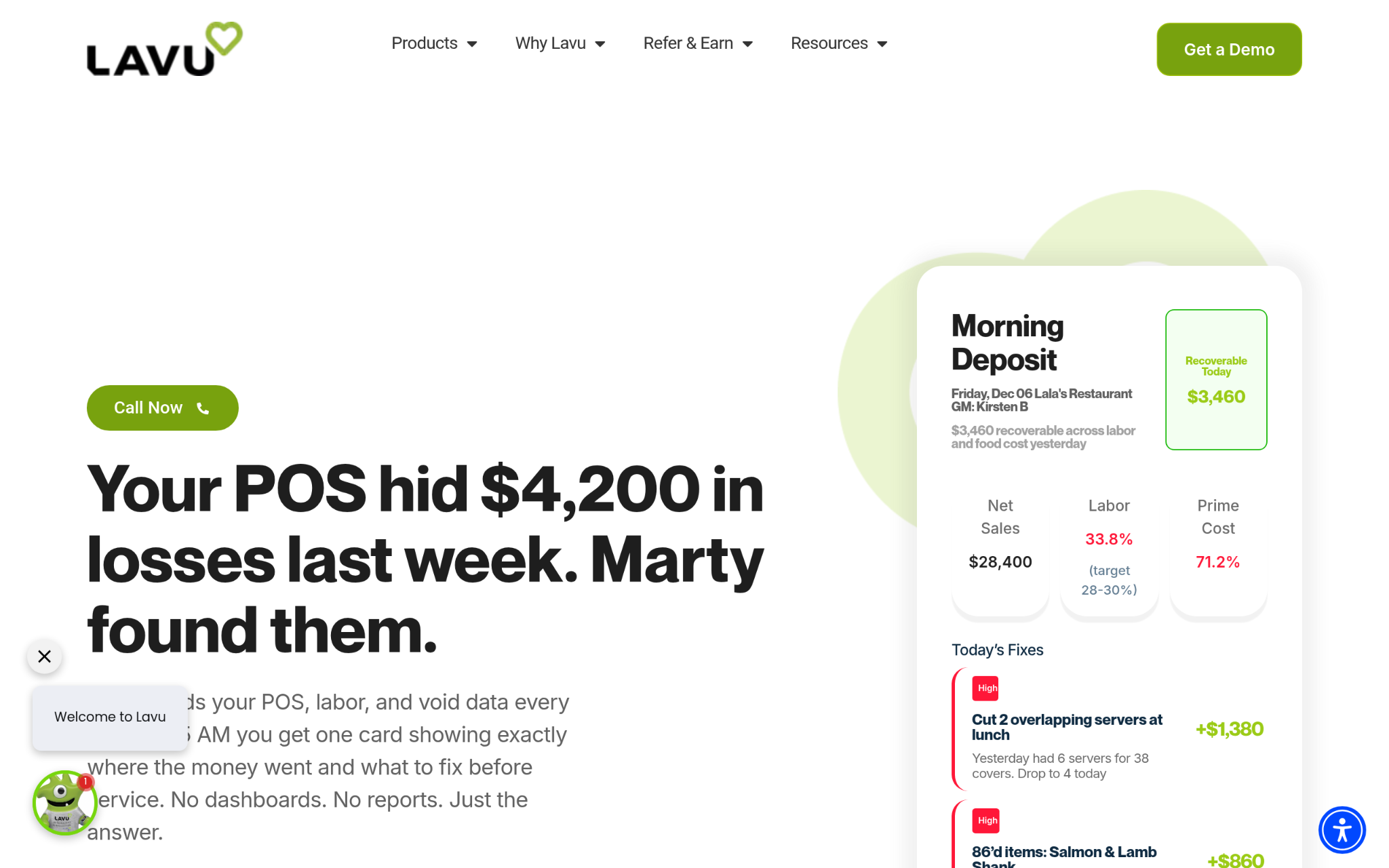
Where Does Lavu Operate and What Is Its Purpose?
Lavu is headquartered in Albuquerque, New Mexico, and built its name as the first iPad-based restaurant POS system back in 2010. The platform has since grown into what it calls a restaurant operating system, powered by an AI layer called Marty that connects POS, payments, labor management, and reporting into one unified view. Having processed over one billion orders, Lavu's scale is real. What stands out is that Marty runs nightly analytics across all connected data and surfaces specific findings, not just reports, showing exactly where costs went and what needs attention before the next service.
What's Lavu's Edge in Restaurant POS Systems?
Lavu takes on the reporting problem that most restaurant operators feel acutely: data exists across the POS, labor, and inventory systems but never shows up in one place in a useful form. Marty's nightly analytics change that by connecting the dots automatically, which is the kind of time-saving that actually shows up in daily operations.
The Review Roundup:
Lavu picked up multiple recognition awards in G2's 2025 cycle, based on verified reviews from real operators. The all-in-one nature of the platform is the most consistently praised feature, especially for smaller teams managing multiple functions without dedicated tech staff. The mobile-first design also gets regular mentions for helping new staff get up to speed quickly (and high-turnover kitchens need every advantage on that front).
-
Smart Tab - Best for High-Volume Nightclubs and Bars
Where Does Smart Tab Operate and What Is Its Purpose?
SmartTab is based in San Francisco, California, and was built for the operational realities of nightclubs and bars, not adapted from a general restaurant POS. The platform runs as a hybrid, combining on-site local servers with cloud infrastructure so that payment processing continues even when internet connectivity gets disrupted. Features like ID-based payment profiles, biometric employee tracking, and custom table maps reflect a solid understanding of high-volume venue management. SmartTab's founding team includes former bartenders, servers, general managers, and owners, and that operational background is visible in how the product handles edge cases that generic systems often miss.
What's Smart Tab's Edge in Restaurant POS Systems?
SmartTab deals with the offline vulnerability problem directly by running on hybrid infrastructure, so a connectivity drop during peak volume doesn't shut down transactions. For high-volume venues where every minute of lost service time directly hits revenue, that architecture matters more than most POS features.
The Review Roundup:
SmartTab has built a solid footprint across major U.S. markets, with a partnership with data intelligence firm Compeat adding a layer of business intelligence that goes beyond standard POS reporting. Venues that operate at serious volume, where a standard restaurant POS would buckle under peak-night order pressure, tend to find SmartTab fits in a way that more general platforms simply don't.
Selection Framework: How Each Pick Was Evaluated
The research behind this list was built from the ground up using publicly available sources across directories, review platforms, and official company websites. No single data point drove inclusion. Instead, each platform was assessed across multiple dimensions to build a picture of real-world performance.
Baseline Information Compilation
The starting point was a broad sweep of restaurant technology directories, software review platforms, and industry case studies. From those sources, a longlist of POS platforms was assembled, covering companies of different sizes, service models, and target restaurant segments. The goal at this stage was coverage, making sure no well-established platform was missed before the filtering process began.
Filtering Candidates Down to Finalists
Once the longlist was built, platforms without verifiable market presence were removed. That meant checking for consistent review activity across multiple platforms rather than relying on isolated testimonials. Companies with review patterns that suggested incomplete adoption or limited real-world deployment were deprioritized. Only platforms with clear evidence of active, ongoing use by restaurant operators made it forward.
Claims Undergo Fact-Checking Review
Every feature claim and performance statement pulled from official websites was cross-referenced against what actual users reported. Where a platform claimed specific capabilities, such as offline payment processing or third-party delivery connections, those claims were checked against review content to see whether operators confirmed them. Discrepancies between marketing language and user experience were flagged and factored into the overall assessment.
Industry Standing Check
Beyond reviews, each platform's broader standing in the restaurant technology space was evaluated. That included recognition from industry organizations, coverage in trade publications, and any original research or data the company had published about its own reach. Awards, client rosters with recognizable names, and verified transaction volume figures were all considered as signals of genuine market credibility.
Real-World Restaurant POS Systems Evidence
The final check focused on whether each company had built real depth in the restaurant POS space rather than treating it as one market among many. Platforms with dedicated service pages covering restaurant-specific workflows, verified reviews from operators describing day-to-day use cases, and case studies tied to specific restaurant types carried more weight. Generic platforms that happened to serve restaurants were distinguished from those built with restaurant operations as the main design consideration.
Choosing the Right Restaurant POS System: A Quick Guide
Picking a restaurant POS comes down to matching the platform's actual capabilities to your real operational needs, not just the feature checklist on a pricing page. Here are the five areas worth examining before committing.
-
Industry/Domain Experience: Look for platforms built specifically for restaurant environments, not general retail systems adapted for food service. Restaurant-specific design shows up in how the POS handles menu modifiers, split checks, and kitchen routing under pressure.
-
Features and Service: Confirm that the platform covers the full workflow your operation needs, from order entry through payment processing, inventory, and delivery platform connections. A gap in any of those areas usually means paying for a separate tool.
-
Pricing Structure: Understand the full cost, including hardware, monthly subscription, and per-transaction fees. Some platforms charge less upfront but take a larger cut of each transaction, which adds up fast at higher order volumes.
-
Results Measurement: Check whether the platform gives you reporting that's actually usable. Table turnover rate, transaction processing time, and labor cost per shift are the numbers that matter, and your POS should surface them clearly.
-
Industry Knowledge and Compliance: Confirm that the platform handles PCI DSS and EMV compliance correctly and supports local tax structures relevant to your market, including tip pooling rules and alcohol sales restrictions where applicable.
Wrapping Up
Choosing a restaurant POS is one of those decisions that touches everything: how fast tables turn, how well your team handles a Friday rush, and whether your delivery orders sync without someone manually entering them twice. The platforms on this list cover a range of operations from high-volume nightclubs to full-service dining. The right fit depends on your service model, your volume, and how much of the operational burden you want the technology to handle for you.