



- 21st May '26
- Sell SaaS
- 9 minutes read
Best Email Services for SaaS Onboarding and Trial Conversion in 2026
Most SaaS teams treat email as a commodity until something goes wrong. A welcome email hits spam on day one or a trial user never gets their verification code, and suddenly you are debugging email infrastructure instead of building products. The provider you pick shapes how much of that lands on your plate.
The best email services for SaaS onboarding and trial conversion in 2026 are Mailtrap, Postmark, Mailgun, and SendGrid. We looked at things that actually matter for onboarding: how fast activation emails arrive, whether transactional and bulk traffic stay separated, and whether the analytics tell you anything useful when something stops working.
Which Email Service Is Best for SaaS Onboarding and Trial Conversion?
| Provider | Best for | Free tier | Starting price | G2 rating |
| Mailtrap | Multi-tenancy & High Deliverability | 4,000 emails/mo | $15/mo | 4.8/5 |
| Postmark | Speed-Critical Activation & Low Churn Risk | Trial credits only | $15/mo | 4.6/5 |
| Mailgun | Pre-Send Validation & Clean Sender Reputation | 100 emails/day | $15/mo | 4.2/5 |
| SendGrid | Multi-Channel Activation & Unified Vendor Billing | 100/day (60-day trial) | $19.95/mo | 4.0/5 |
G2 ratings as of May 2026.
The right pick depends on what your onboarding flow actually requires:
-
Choose Mailtrap when high deliverability on signup and verification emails is the priority, you send onboarding emails on behalf of multiple customers or workspaces
-
Choose Postmark when magic-link logins, two-factor codes, and trial activation emails need to arrive in seconds, not minutes.
-
Choose Mailgun when pre-send address validation and routing control are core to your onboarding flow.
-
Choose SendGrid when your SaaS already runs on Twilio and you want onboarding email, SMS notifications, and voice alerts under a single billing account.
Best Email Services for SaaS Onboarding in 2026
1. Mailtrap: Best for Multi-tenancy & High Deliverability
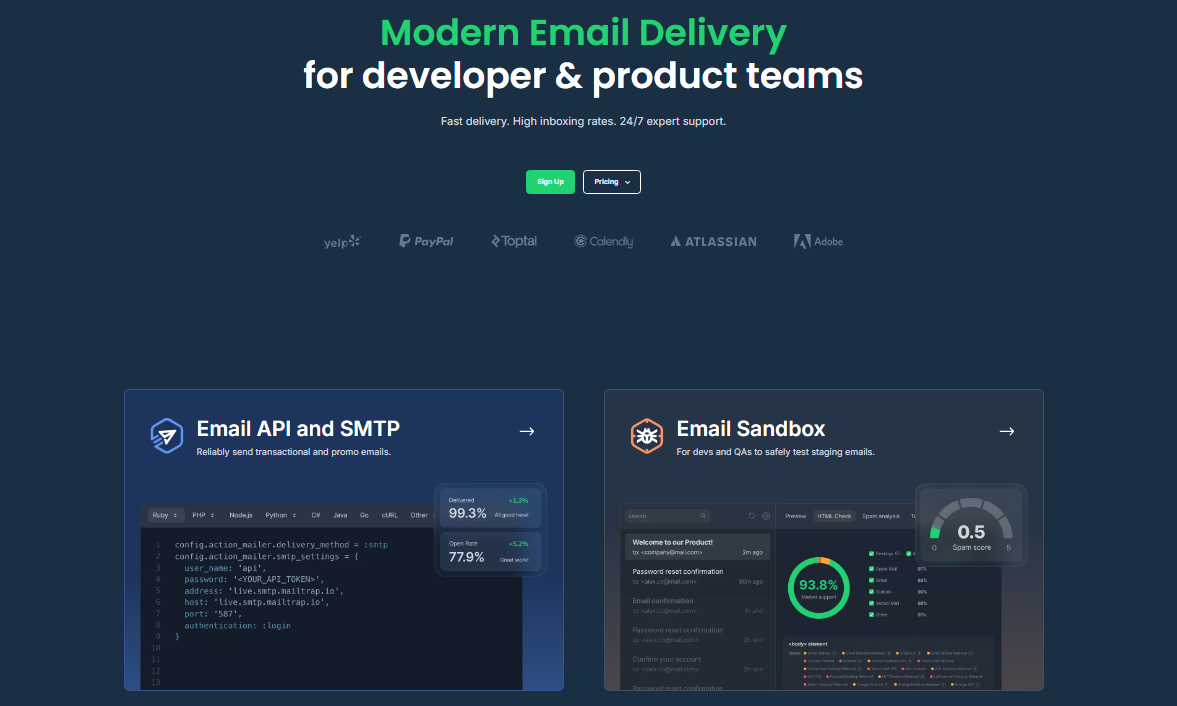
Mailtrap is an email sending API built for developers and product teams. The thing that makes it relevant for SaaS onboarding is stream separation: transactional and bulk traffic run on isolated infrastructure by default.
Most SaaS apps send two very different types of email. Verification codes and password resets on one side, feature announcements and trial nudges on the other. When those share one IP pool, a promotional campaign with a soft-bounce spike can suppress the signup emails that activate new users. Mailtrap keeps them apart without any configuration on your side.
SPF, DKIM, and DMARC are configured automatically once DNS records are added. DKIM keys rotate monthly, so stale key decay does not quietly break inbox placement weeks later. Dedicated IPs on the Business plan include automatic warmup.
Onboarding and Integration
Setup runs under 5 minutes from account creation to first send. Official SDKs cover Node.js, Ruby, PHP, Python, .NET, Elixir, and Java, with 25+ framework snippets for Laravel, Symfony, Django, Rails, and Next.js. Native integrations cover Vercel and Supabase. An MCP server lets AI coding tools like Claude Code send onboarding emails and run sandbox tests without any wrapper code.
Analytics for Conversion Visibility
Reports break out delivery, opens, clicks, bounces, and spam complaints by mailbox provider, domain, and stream. That provider-level split is useful: it tells you whether your welcome email has a Gmail problem or an Outlook problem, rather than a blended rate that hides which one. Logs retained for 30 days. Webhooks fire on all delivery events with 40 retries over five minutes.
Pricing
Free tier covers 4,000 emails per month. Paid plans start at $15/month for 10,000 emails. Business is $85/month for 100,000 emails with a dedicated IP and automatic warmup. Enterprise starts at $750/month for 1.5 million emails.
Best for: developers and product teams that need high deliverability of onboarding emails and granular analytics to see exactly where activation messages land.
2. Postmark: Speed-Critical Activation & Low Churn Risk
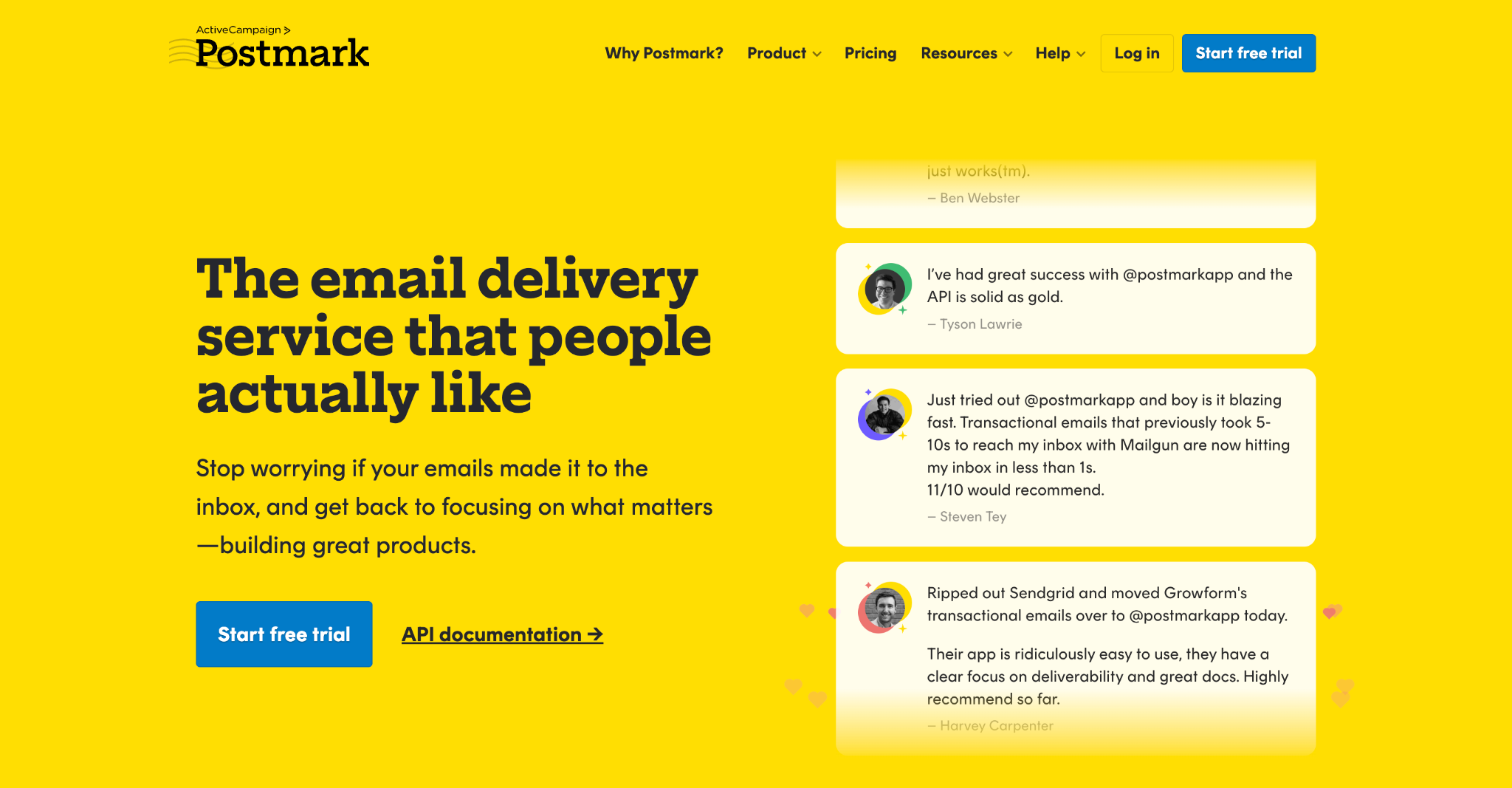
Postmark’s main advantage is that it gets transactional email to the inbox fast. Magic-link logins, email verification codes, two-factor authentication and trial confirmation make that happen. Those are the messages that directly gate user activation, and they all have a patience window of about 30 seconds before users give up and close the tab.
The platform runs a strict account review before enabling live sending, which keeps the shared IP pool clean. Similar to Mailtrap, it separates traffic into Message Streams at the infrastructure level. Each stream carries its own IP reputation, so a broadcast campaign cannot suppress your signup flow.
Onboarding and Integration
Account review typically clears within a business day; setup runs 5 to 10 minutes after that. Official SDKs cover Node.js, PHP, Python, Ruby, .NET, Java, and Go. Message Streams are first-class API objects: pass a stream ID on each send and Postmark routes traffic with clean reputation isolation per stream.
Analytics for Conversion Visibility
Activity logs are retained for 45 days, more than any other provider here. Every bounce is automatically categorized and suppressed, so list hygiene stays clean without manual work. Webhooks cover delivery, bounce, open, click, and spam complaint events. SOC 2 Type II certified.
Pricing
Starts at $15/month for 10,000 emails. 50,000 emails runs $60.50/month. 125,000 costs $138/month. Dedicated IP is $50/month, gated to accounts sending 300,000 or more emails per month. There is no permanent free tier.
Best for: SaaS products where activation emails need to arrive fast. Magic-link auth, two-factor codes, trial confirmation. Every minute of delay increases churn risk.
3. Mailgun: Pre-Send Validation & Clean Sender Reputation
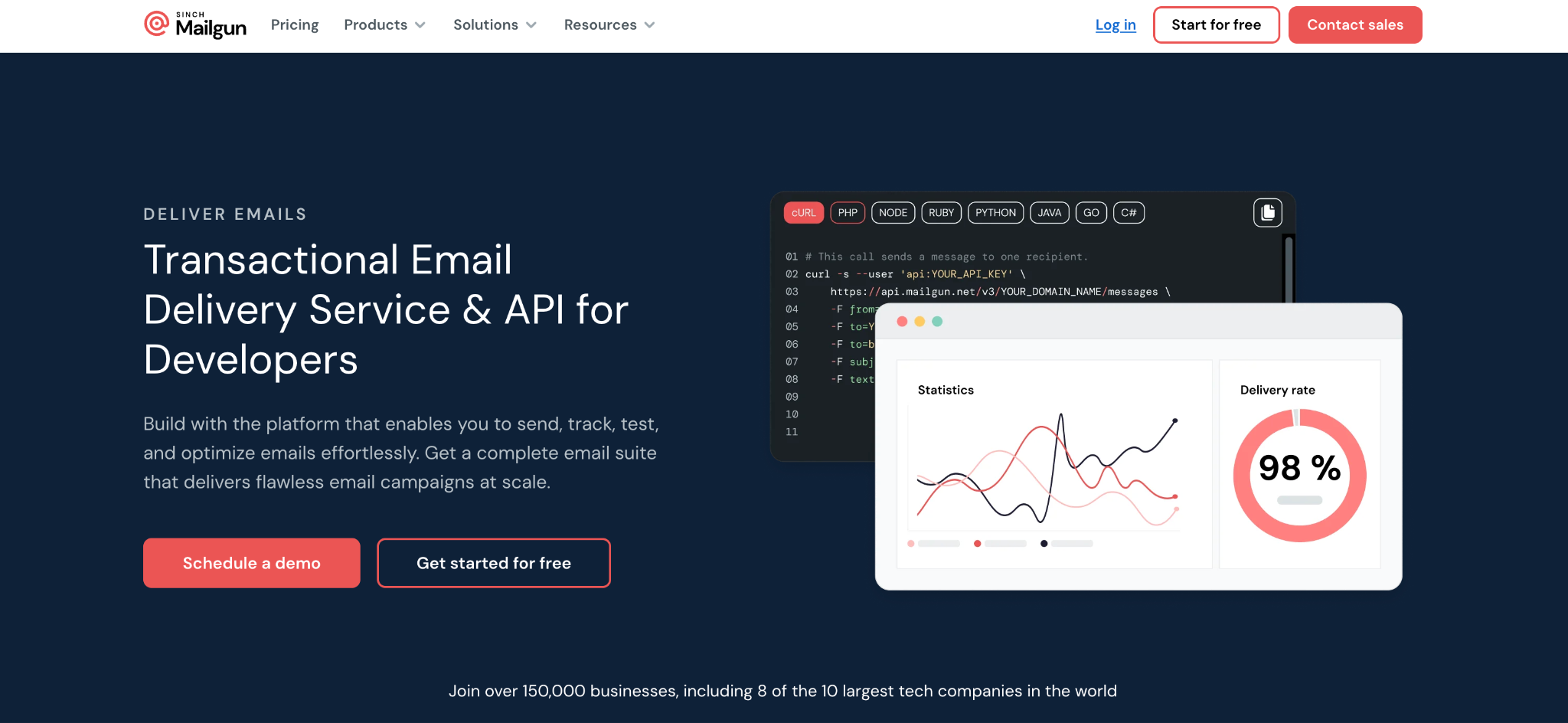
Mailgun is an API-first email service for engineering teams that need precise routing control. The two features that set it apart for onboarding are per-domain API keys and a built-in email validation API. Both matter if you send on behalf of multiple customers, or if your signup flow collects addresses you cannot fully trust.
The validation API checks addresses against DNS/MX records, disposable domain lists, and syntax rules before sending. It catches bad addresses at the point of signup rather than after they generate hard bounces.
Onboarding and Integration
Setup runs about 10 to 15 minutes for DNS records, domain verification, and API key configuration. Official SDKs cover Node.js, Python, PHP, Ruby, Java, Go, and C#. The PHP SDK records over 1.3 million weekly installs on Packagist. Domain-specific API keys isolate per-customer sending, so a deliverability problem in one tenant does not bleed into another. Batch sends accept up to 1,000 recipients per API call with per-address recipient variables.
Analytics for Conversion Visibility
Webhooks retry for 8 hours on failure. Event log retention on the base plan is 5 days, the shortest of these four providers. That window makes diagnosing onboarding issues harder when problems surface a week after they started. SOC 2 Type II and GDPR compliant. Scale plans include a 99.99% uptime SLA.
Pricing
Free tier covers 100 emails per day. Paid plans start at $15/month for 10,000 emails. Foundation is $35/month for 50,000 emails. Scale starts at $90/month for 100,000 or more. Dedicated IPs cost $59/month. Overage runs $1.80 per 1,000 emails.
Best for: multi-tenant SaaS products where per-domain isolation and pre-send address validation directly protect sender reputation.
4. SendGrid: Multi-Channel Activation & Unified Vendor Billing
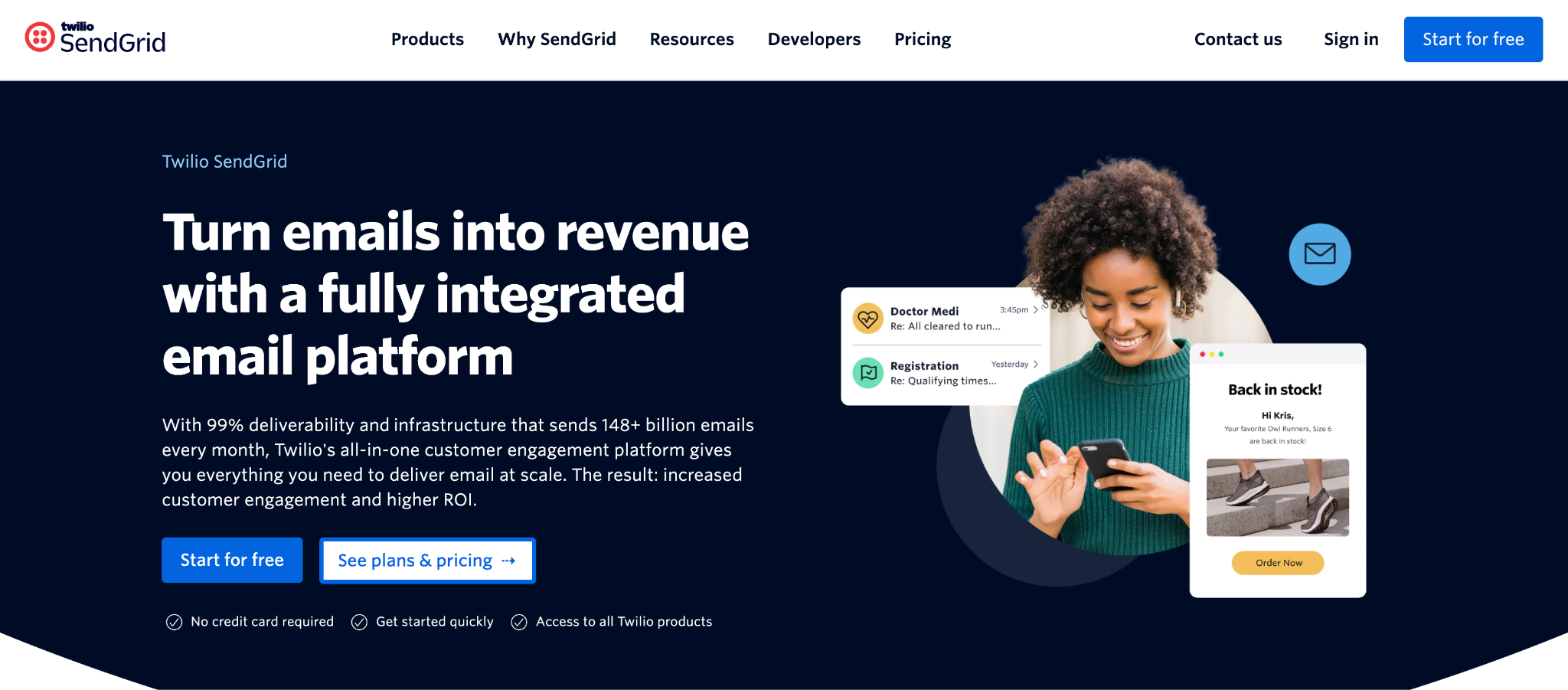
SendGrid is the most widely deployed transactional email service in the market. Its PHP SDK has over 44 million installs on Packagist, and most major frameworks have a community integration already written. For teams where half the engineering org has used it before, there is less ramp-up time on the email side.
The Twilio angle is its clearest differentiator: if your product sends verification codes via SMS or uses voice as a fallback, SendGrid puts all of that under one billing account.
Onboarding and Integration
Official SDKs cover Node.js, PHP, Python, Ruby, Java, Go, and C#. Dynamic templates with server-side Handlebars are a first-class feature for personalized onboarding sequences. Stream separation is not built in. Teams approximate it through IP pools or subuser accounts, both requiring manual configuration.
Analytics for Conversion Visibility
Event webhooks retry for 24 hours after a failure. Activity logs retain for 30 days on paid plans. SOC 2 Type II certified and GDPR compliant. Customer support response times are a recurring G2 complaint, worth knowing if you ever need fast help with a delivery issue.
Pricing
Free plan covers 100 emails per day during a 60-day trial, then expires. Essentials starts at $19.95/month for 50,000 emails. Pro is $89.95/month for 100,000 emails. Premier is custom-quoted.
Best for: enterprise SaaS teams already inside the Twilio ecosystem who want onboarding email, SMS verification, and voice fallback on a single billing account.
What Makes an Email Service Good for SaaS Onboarding?
Not every email platform is built with SaaS onboarding in mind. Four questions worth asking before you commit to one:
Does it protect your signup emails from bulk traffic?
The most common deliverability problem in SaaS onboarding is a promotional campaign damaging the sender reputation that verification and welcome emails depend on. Mailtrap and Postmark separate transactional and bulk traffic at the infrastructure level by default. The others require manual IP pool or subuser configuration to approximate the same isolation.
How fast do activation emails arrive?
Magic-link logins, two-factor codes, and email verification gates have a short patience window. Delays over 60 seconds produce measurable drop-off in trial signup completion. Postmark is specifically built for speed here. Mailtrap and Mailgun are both reliable on delivery time.
Can you see exactly where onboarding emails land?
Blended open rates are nearly useless for diagnosing onboarding problems. If your welcome email is landing in Gmail spam but hitting Outlook inboxes fine, a blended 28% rate tells you something is wrong but not where. Mailtrap breaks delivery events down by mailbox provider, domain, and stream. Postmark's 45-day log retention helps when the problem started a week ago and you are only finding out now.
Does it handle pre-send address validation?
Trial signups generate bad addresses at a meaningful rate: disposable inboxes, typos, fake domains. Hard bounces from those addresses damage sender reputation and suppress delivery for legitimate users. Mailgun's validation API catches bad addresses at signup rather than after the bounce. The other three providers here rely on post-send suppression instead.
Final Verdict
Email is one of the things SaaS onboarding absolutely depends on. A verification code that takes three minutes and a welcome email in spam erode the first-day experience that determines whether a trial user converts. Most teams only find out something is wrong when signups drop.
Mailtrap is the strongest all-around pick: high deliverability, native stream separation, and analytics that tell you which mailbox provider is causing the problem rather than just that one exists. Postmark is worth it when activation speed is the single constraint. Magic-link logins, two-factor codes, anything with a 30-second patience window. Mailgun fits multi-tenant products where per-domain isolation and pre-send validation are core, not nice-to-have. SendGrid makes sense if you are already on Twilio and want email, SMS, and voice under one account.